



 Login
Login
 Subscribe
More than 12,000 coral fragments planted

More than 12,000 coral fragments are now growing on Samoa’s reefs following a restoration program that trained communities across seven sites to lead reef recovery efforts, conservation officials said.
The work was carried out under the Kiwa RESTORE Project, funded by the Kiwa Initiative and implemented by Conservation International in Samoa, Timor-Leste and Fiji. The initiative brought together government representatives and selected communities to build local capacity in coral reef restoration, reef star deployment, coral ecology, monitoring and community-based conservation.
A closing ceremony for a Training of Trainers (ToT) program on coral reef restoration and reef star installation was held on Friday at Samoa Beach Resort in Mulifanua, marking the end of two weeks of theoretical and practical training. The event also signalled the completion of restoration activities at seven pilot sites.
During the practical phase, participants established seven coral restoration sites across Faleatiu, Lalovi, Fuailolo’o, Salua-uta, Apai-uta, Samatau and Matautu Falelatai. At each site, 100 reef stars were installed, with about 1,800 coral fragments attached per site, totalling 700 reef stars and approximately 12,600 fragments across all locations.
Officials said the effort represents a significant step toward restoring degraded reef areas and strengthening the resilience of coastal ecosystems and communities.
The ceremony opened with a devotion led by Bishop Mulipola Oliva of Salua-Uta, who emphasised the spiritual responsibility of protecting marine resources and caring for creation for future generations.
In remarks, Conservation International Samoa Director Le’ausālilō Leilani Duffy credited strong partnerships between government agencies, communities, trainers and donors for the program’s success. She said the completion of the first seven sites marks an important milestone while paving the way for future restoration work in additional communities.
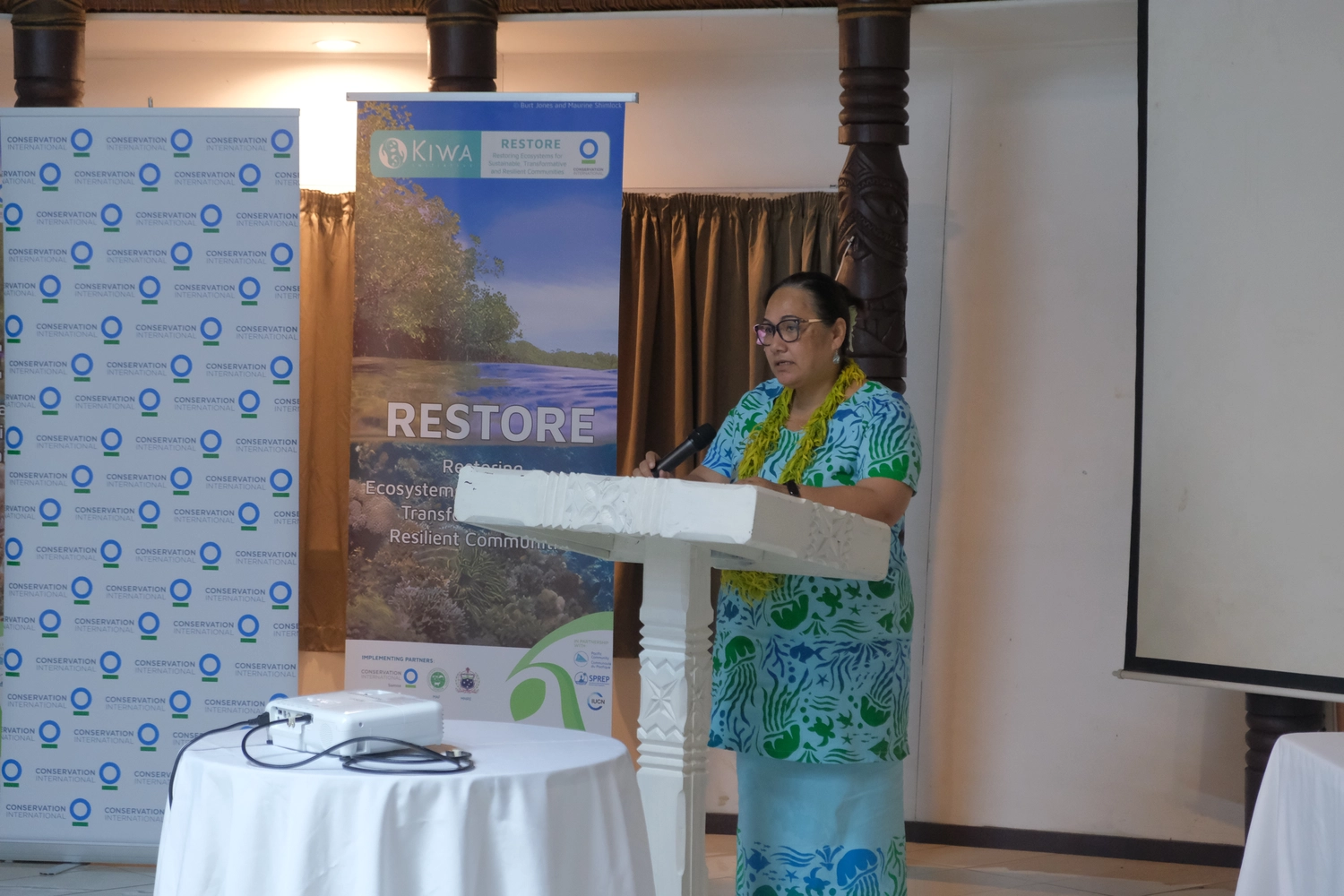
Duffy also highlighted regional collaboration within Conservation International, including technical support and knowledge-sharing from Fiji-based colleagues.
Kiwa RESTORE Project Lead Veniana Vonosese of Conservation International Fiji praised participants for their commitment and highlighted the value of cross-country cooperation in strengthening coral restoration efforts across the Pacific.
The Ministry of Agriculture and Fisheries also welcomed the initiative. Acting Assistant Chief Executive Officer of the Fisheries Division, Tologatā Tamaleaoa Leilua, said the program strengthens partnerships in addressing climate change impacts, coral degradation and pressure on marine resources. He said the collaboration supports community-based fisheries management and coastal resilience efforts.
Participant Tanuvasa Joyita described the training as a valuable first experience in coral restoration, saying she planned to share the knowledge with her village and family to promote marine conservation awareness.
The ceremony concluded with the presentation of certificates of completion to participants.
“Coral restoration is not a one-time activity,” Duffy said. “It requires continuous care, monitoring, learning and collaboration. The small coral fragments planted today represent hope for healthier reefs, stronger fisheries, resilient communities and a sustainable future for Samoa.”
The Kiwa RESTORE Project continues to support nature-based solutions and community-driven conservation aimed at strengthening the resilience of Samoa’s coastal ecosystems in the face of climate change.




