



 Login
Login
 Subscribe
First historical novel focused on Samoa’s women Mau

A groundbreaking historical work is reshaping the narrative of Samoa’s independence struggle by placing women of the Mau movement at the centre of the story for the first time.
“Tattooing Sina” by Moneka Tupua Knight focuses on the Samoan Women’s Mau movement, a project the author says has been a dream for 25 years.
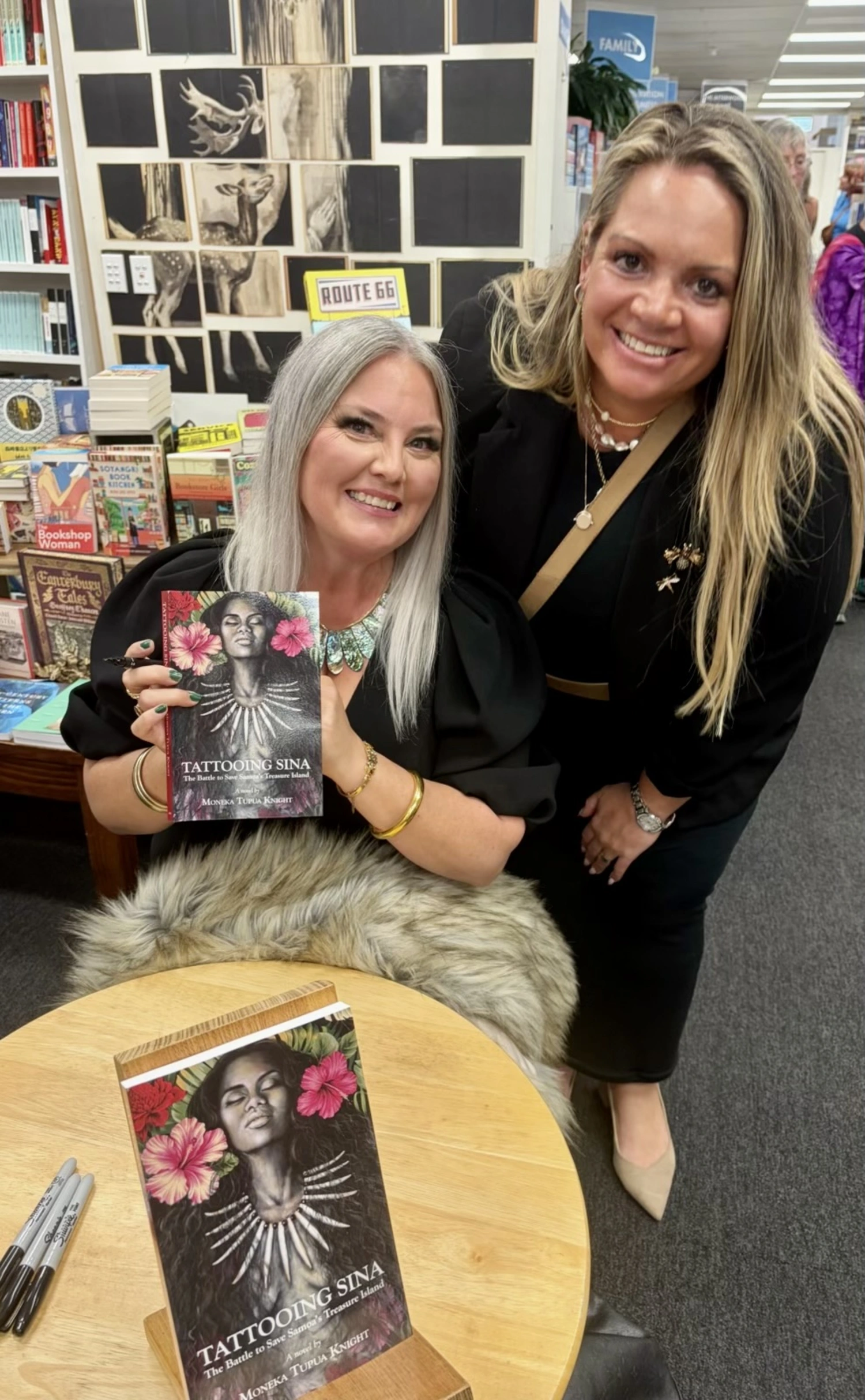
“My father-in-law, the late Fuimaono Na’oia Fereti Tupua, told me about the Women’s Mau and the incredibly courageous women who fought against corrupt and often violent New Zealand colonisers. This was a family story that included information about our Tupua ancestors. I was disappointed I couldn’t find information about these women. Papa then suggested I tell their story and that is why I dedicate the book to him,” Ms Knight said.
The story follows a taupou named Sina, whose father is fined after she receives a malu. To pay the fine, she works at Vailima for Fanny Stevenson, the wife of Scottish author Robert Louis Stevenson.
“Fanny is an incredible woman whose life and successes are overshadowed by her famous husband. This is the first book that is written from her viewpoint. She created the Vailima homestead and plantations, and inspired many of her husband’s most famous characters, but her literary work and contributions are ignored,” she said.
In the book, Fanny Stevenson encourages Sina to write and become politically active during a period spanning the late 1800s to the early 1920s in Samoa.
Ms Knight said that after Mau leader Tupua Tamasese Lealofi was assassinated in 1929, the Mau men went into hiding, and women took over the resistance.
“After Mau leader Tupua Tamasese Lealofi was assassinated in 1929, the Mau men went into hiding, so the women took over the resistance movement. These women were incredibly brave because the New Zealander policemen had guns,” she said.
She said early accounts downplayed the women’s role, but family stories and research showed their political strength.
“Information I initially found downplayed their role, saying the main thing they did was to smuggle food to the men in hiding, but Papa told me how politically strong this women’s resistance group was,” Ms Knight said.
Her research was supported by academic work including Lisa P. MacQuoid’s paper “The Women of the Mau,” along with other studies, family stories, and newspaper articles.
“This research was critical. I also used family stories and newspaper articles to develop the content of the book. These helped prove the key role these women played in Samoa achieving independence,” she said.
The book also highlights protest marches in Apia, kirikiti matches after the game was banned, and a Samoa-wide malaga across the south and west coast.
“I loved writing about the malaga and it was widely reported on throughout the region so I was able to find articles about it. I have been to many of these villages, and it was a joy to imagine how powerful these women’s only ceremonies must have been to inspire the people to fight for independence,” Ms Knight said.
“Tattooing Sina” has been launched in Australia and has gone into its second print run after strong sales. It is available on Amazon.com and in selected local shops.
Ms Knight said she plans an official launch in Samoa in July and seminars at the National University of Samoa, where she previously lectured in Journalism, hoping to inspire the next generation of Samoan writers to tell their own history and culture.




